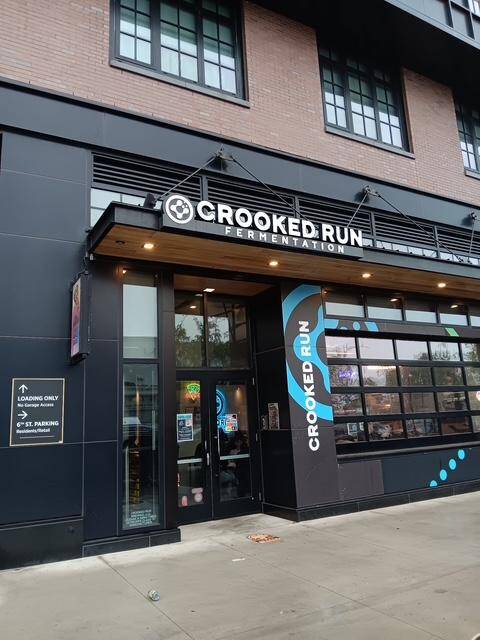
The weather in DC was rainy most of Memorial Day weekend, but it let up as we left one brewery and headed to another. Crooked Run Fermentation was not far from Lost Generation. Crooked Run is in the Union Market area of the city.
The brew house was a modern open and bright place. They served food, but we had just eaten so it was just beer here. I had a Thunder Pale Ale. It is an easy drinking ale that was not too far off the Vienna I had earlier. It had Vienna malt in it, in fact. Centennial and Cascade hops are used and it had a bit of hoppiness at the finish. I don't know the IBU's, but is was probably in the 20's. I'm not sure what one of my brothers had, but the other had the Best Days, which is a Hefeweizen. Crooked Run also makes some wine and seltzers, which sources its grapes and fruits from Virginia. They are also one of the only breweries in the US that follows the Belgian Lambic specifications when brewing. Lambic beers are unique in their fermentation process. It was not until 1965 that this process was actually decreed, with the Royal Decree.
Taken from https://horal.be/en/traditional-lambic-beers/
This Royal Decree stipulated that the names lambic, geuze, geuze-lambic and also their compounds or derivations could only be used to indicate a spontaneously fermenting beer. The wort must be brewed with at least 30% of the wheat and the density of the wort must be at least 5 Belgian degrees. At first glance, this Royal Decree offered bona fide brewers the necessary protection. In practice, however, its application was never checked. Moreover, this Royal Decree ignored the reality that two totally different products, the real geuze and the filtered and sweetened geuze, continued to bear the same name. Subsequent amendments in 1973, 1974 and 1993 also ignored this reality.
Protections were probably derived from the Germans, who were very specific in their guidelines and regional guarantees. Beer was taken far more seriously in Europe than in America, where most of our beers were variations of what was brewed in Europe long before we were a country.
TSG – traditional speciality guaranteed
A register is kept of regional products recognized in one of these categories.
- the protected designation of origin (PDO)
- the protected geographical indication (PGI)
- the traditional speciality guaranteed (TSG)
Strict rules apply to each protected product: a set process and a defined area of production. In principle, the products are protected against counterfeiting only within the EU, so counterfeiting from non-EU countries is not protected. Global protection is difficult within the World Trade Organization (WTO).
Regulation (EEC) No. 2301/97 of November 20, 1997, and the corresponding specification of January 21, 1997, distinguish lambic and geuze beers according to the raw materials used and the brewing process. Beers brewed according to the old recipe may add the designation “Oud” or “Oude”.
Thus, Oude lambiek has since been lambic beer made with at least 30% wheat and which has undergone integral spontaneous fermentation. “Oude geuze” is created by blending 100 % old lambic of spontaneous fermentation with a weighted average age of at least one year and the oldest of which has aged in wooden barrels for at least three years. The mixture must undergo secondary fermentation in the bottle and must meet a number of biochemical requirements after six months of aging in the bottle. “Oude Kriek” must also have been refermented in the bottle. For gueuze and kriek, which may not bear the preface ” Oud” or “Oude,” the requirements are much less stringent; lambic beers must not be that old, there must be no secondary fermentation in the bottle, and filtering, sweetening and pasteurization are permitted.
That was a long way to go to tell you Crooked Run follows these rules. I must admit, I did not know of these rules before looking it up and, most likely, neither did you, but brew masters and beer geeks would. Traditional recipes are harder to follow and many breweries in the US have made their name by experimenting with stuff. So, a purest would care, while the casual beer drinker would not. It just comes down to how you market your products and you can't call something that it really isn't in Europe.
If you find yourself in DC and want to check out Crooked Run Fermentation, it would be worth your time. The best thing to do would be to sit down with a beer made with traditional process's and one that is not and see what you think.
Add comment
Comments