I occasionally get on a roll where I read a ton of books on one subject. My last one was and epic tear through World War I, where I read 21 books in short order. I just couldn't get enough and it ran the gambit from the Eastern and Western Fronts, Italian campaign, Gallipoli, air war, the Zeebrugge raid, etc. Then, I burn out and don't read for awhile. I get like that with documentaries too and in the run up to the Fourth of July and our 250th celebration, I was consuming Revolutionary War and Founding Father documentaries at an amazing clip. There are a few that no one should watch based on their woke agenda, but if the creator is smart, they just report the history and leave the other bullshit alone.
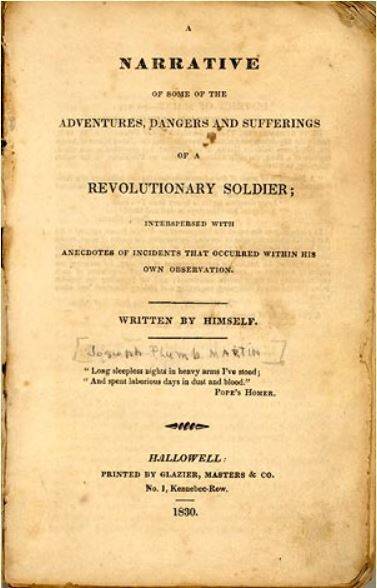
I admit, I think George Washington is the greatest of all patriots based on his actions and what he meant to the country after the war. Yeah, you've heard me say it before. I digress. There is another figure who most people have never heard of and he gets no props, but if you watch enough documentaries, he's quoted regularly. He's quoted because he was one of the few soldiers to ever write a book about his time in the Continental army. His original journal has been lost, but his narrative is easily available, and comes in various versions, if you look for it. The one I read is called, A Narrative of a Revolutionary Soldier, Some of the Adventures, Dangers and Suffering of Joseph Plumb Martin. I urge you to read it. He may be my favorite person of the revolution. Washington is the greatest and everyone should see Young Washington if you haven't, but JPM gives you a perspective you will not get otherwise. He was an uneducated 15 year old who joined the Connecticut militia in 1776 to fight for his country and other than a short time he took off when his enlistment was up, he joined the Continental army in 1777 and fought until war's-end in 1783. He was in many major battles and his story is compelling. It it not a war story, as he barely gets into any of the battles he was in. It was about the every day life of patriotic soldiers who fought for independence. If you are unaware of the destitute lives our soldiers lived in during this time, it will be an eye-opener.
"So I wrote my name fairly upon the indentures... I was now what I long wished to be, a soldier. I had obtained my heart's desire, it was now my business to prove myself equal to my profession." Joseph Plumb Martin
The constant starvation and lack of clothing and lack of care they received is utterly amazing that anyone would stay and fight in an army like that. However, none of us have ever had to fight for our freedom before and the I know had I been there, I'd have done it too. Having to rely on the citizenry for any kind of lodging, many of who were Tories and were not friendly to their cause, is also jarring. Disease, starvation and accidents befall him in every chapter. The stories we've all heard about at Valley Forge were not only true, but worse than described. Soldiers with no shoes or pants in winter, having to eat shoe leather, tree bark or nothing at all brings it all home. Until 1782, after we had won the Battle of Yorktown, which he was in the middle of, every chapter is full of starvation. He was injured many time, and only once as a result of battle, had been inoculated with smallpox and caught Yellow Fever near the end and almost died from it. He only mentions getting paid one time, so most of these young men fought for nothing. He grows from an oblivious 15 year-old to a wily 21 year old veteran over the course of the book and is considered a good soldier by his officers in the 17th Connecticut Regiment. He's promoted several times and does receive a preferential assignment or two, including getting extended furloughs, but much of it is the mundane things soldiers are ordered to do.
When you consider all he saw and did, his time as a soldier is amazing. I wonder how many other young men fought as long as he did? I'm not sure if this was common or not. His first battle was Brooklyn Heights, he nearly was captured at Kip's Bay and fought in the loss of White Plains, led by George Washington in all three. He suffers through the long winter at Valley Forge and is trained by the Marquis D' Lafayette. He was an actual witness to the cannonball going between the legs of Molly Pitcher at the Battle of Monmouth. He watches John Andre being escorted to his execution at West Point and later is recommended by his superior officers to join a Sapper and Miners regiment and is promoted to sergeant. He fights in the pivotal battle for Redoubt #10 at Yorktown, led by Alexander Hamilton as he helped cut through the British log ramparts and then sieges the walls. He witnesses the surrender of the British and remarks at the cowardice of Cornwallis for not taking part in the ceremony. All of this is well known history, but his perspective is that of the common man. No glory, no ceremony, just suffering and marching and surviving. I bet he marched 500 miles as an infantryman, always hungry, in two feet deep snows, in rain and mud and in the suffocating heat wearing wool the whole time. Many times sleeping in fields with no tent. He eats things that cause him to be violently sick several times as one would while starving, helps himself to farmers fields or finding animals, fruit and nuts in the forest. Very few of us can imagine having to forage to stay alive and be combat ready. Today, our military is well taken care of, back then, with survival and victory unlikely, no help was coming. Of course, people were far more accustomed to hardship than we are today and were simply better prepared for it.
I confess I felt a secret pride swell my heart when I saw the "star spangled banner" waving majestically in the very faces of our implacable adversaries, Joseph Plumb Martin
These are the kinds of people it took to win our freedom and I cannot help but have the highest admiration for Martin. In fact, I love the guy. His book is essential reading. I went to Yorktown, I climbed the walls of Redoubt #10, I saw where the artillery batteries were built and moved forward, ever forward, to bring their full weight to bear on the surrounded British, giving them no option, but to surrender. Joseph Plumb Martin's story shows just how improbable our victory was. To take an army of young men, with little training, no supplies, no food and little help from the people to fight the strongest army of the day and win is just amazing, but it is our story and it is why this nation has been so successful ever since our Declaration. Freedom is why we fight, why we succeed and why we don't quit. Our adversaries have never understood the American psyche and this story is an example, shing brighter than the sun, why we are who we are.
We must go through it, and we did go through it, and I am yet alive. Joseph Plumb Martin
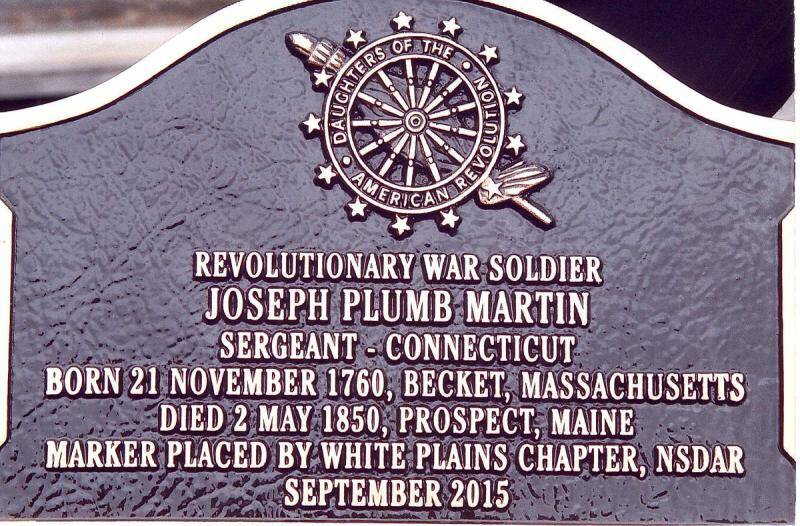
JPM had an interesting post-war life as well. He was a teacher, a farmer, a Justice of the Peace, a Town Clerk, husband and father of five and fought for veterans to get the wages they had earned. It took years, but he was successful, and obtained a $96.00 per year for life pension. He published his narrative in 1830, in part, to help veterans and at the time it was considered unsuccessful. It disappeared into oblivion for 120 years before a first edition copy was found in a library in Maine. That first edition copy is now in the Library of Congress. This chance discovery led to a republishing in 1962 and again in 2001 and 2006. The historical significance of his narrative is now considered essential to historians and even though I mentioned earlier, JPM got no props, he actually did. The trail surrounding Valley Forge National Historical Park is called the Joseph Plumb Martin Trail. To persevere through unbelievable hardships, injuries, sickness and non-stop discomfort and never lose his rebellious spirit to fight for the freedom we enjoy today, makes Joseph Plumb Martin a hero. He may not have achieved glory on the battlefield, but the fight for independence would have been impossible if not for sacrifices of ordinary Americans like him. God Bless him and the thousands of other JPM's we will never know of.
Add comment
Comments